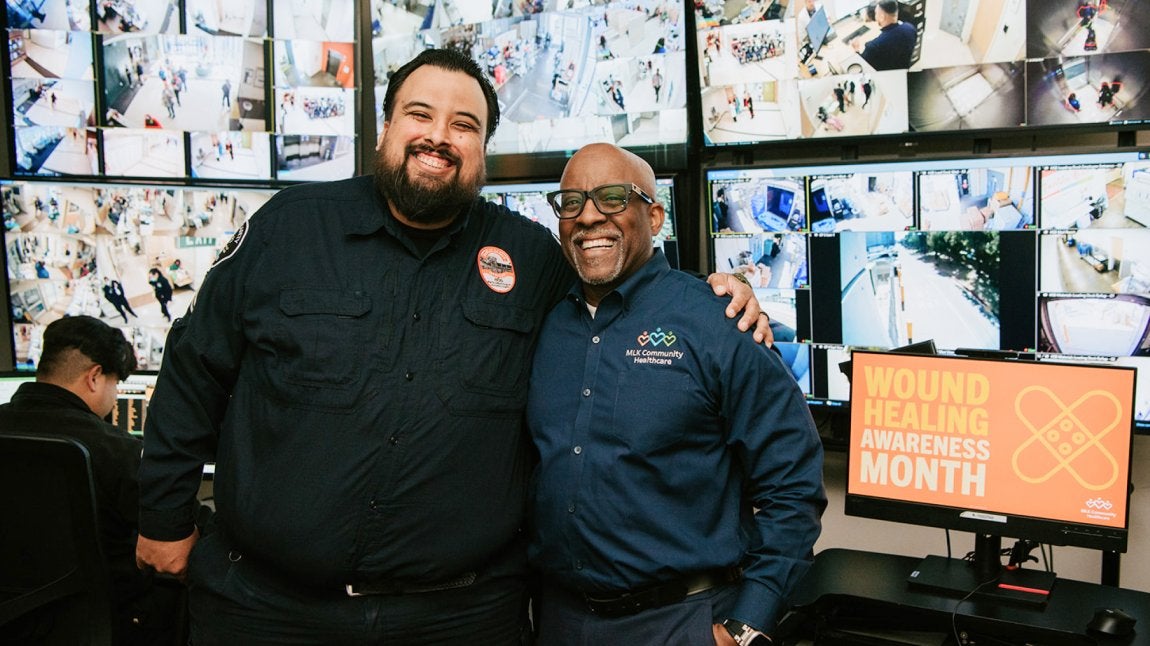
Franky Barrera covers a lot of ground each day at MLKCH. As a lead public safety officer, he’s constantly moving from one end of the hospital to another—checking on his team in med/surg, jumping in to calm down a patient in the ED, taking a stop to welcome visitors queuing up in the main lobby. Wherever he goes, greetings ring out towards him. “What’s up, Franky?” “Hey Franky!” “Good morning, Franky!”
“I’m a people person,” says Franky. “I can kick it with anyone.”
It’s fitting for someone as gregarious as Franky to work in patient and visitor safety at the hospital. Though he began his career in public safety at a hospital in Orange County, it was when he began working at MLKCH that he understood the depth of impact he could have on a community. He arrived in the spring of 2020, in some of the hardest-hit months of the pandemic. “It was the worst I’ve ever seen in healthcare,” he says.
Visitors in the hospital’s lobby were Face timing family members who were intubated and alone in hospital beds. Everywhere he looked, people were anxious and frantic for any news of their loved ones. “Who are you looking for?” he’d ask a visitor. “If things weren’t so busy,” he says, “I’d go check on them in the ICU. Ask the nurse for any info, just try to put them at ease a little.”
That kind of compassion and patience are what helped Franky survive the challenges of the pandemic. And he credits the strengthening of those traits to his eight-year-old son, Grayson, who is autistic. Grayson’s mentality is closer to that of a four-year-old, and he attends special education classes at school. For Franky, his wife and two other teenage children, life with Grayson means that “we all learned a lot about patience.” His wife is now Grayson’s full-time caretaker, and his daughter has grown as a helper with her brother. Watching them care for Grayson has been another unexpected source of growth for Franky.