Hearing Her Community

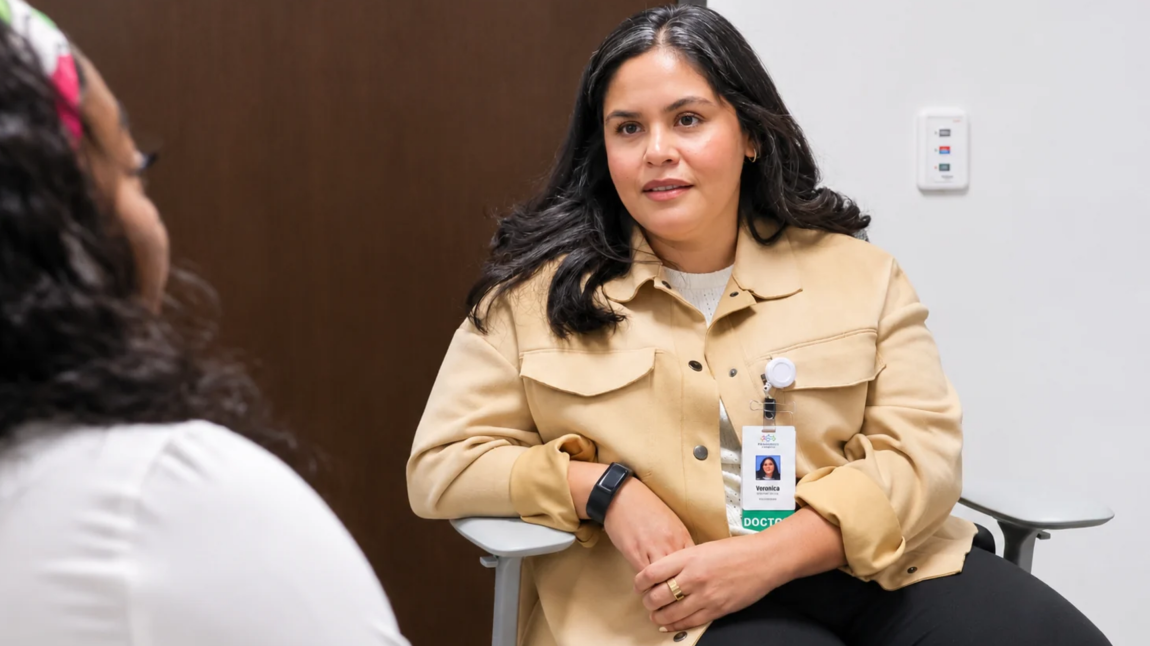
Woman smiling

Dr. Veronica Franco often asks her patients, “What did you hear about mental health growing up?” Her patients’ memories are clear: “I remember telling my mom I felt sad, and her telling me to go wash dishes.” Or, “My parents would say depression is just a weakness of the mind,” or, “I’ll give you a real reason to be sad.” Taken together, the responses paint a similar picture: “The mental health stigma in our community,” says Dr. Franco, “is so real.” 

That stigma is one that Dr. Franco grew up with herself. She was raised in a Spanish-speaking household in Huntington Park, in southeast LA, the daughter of Mexican immigrants. Her patients’ responses are familiar because they’re ones she remembers hearing too. Therapy isn’t for people like us, it’s for other people. 

She always knew she wanted to help others. At first she set out to become a pediatrician. Along the way though, Dr. Franco became involved with the counseling center at UC Irvine and discovered a different kind of impact she could make on peoples’ health—their mental health. After earning her PhD in clinical, counseling and school psychology at UC Santa Barbara, she joined the Integrated Behavioral Health team at MLKCH. Dr. Franco has been working as a therapist at the Wilmington Clinic since November 2025. “My intention was always to come back to my community,” says Dr. Franco. 

My intention was always to come back to my community.

Dr. Franco

South LA’s community has long needed more mental healthcare providers. The patients Dr. Franco sees are majority Black and Latino, and almost all of them are experiencing some combination of financial insecurity around the rising prices of food and gas, post-traumatic stress disorder, and housing insecurity. Increasingly, she has become a safe, confidential space for patients to process their feelings about the painful impacts of immigration raids happening in their communities. Her shared background—low-income, bilingual, Latina—is an advantage. She uses it to help her patients recognize systemic issues beyond their control, such as microaggressions, racism, and the unfairness of being justice impacted. It can be very powerful, says Dr. Franco, for a patient to see someone who looks like them, who has training and credentials, to say, “What happened to you wasn’t right.” 

Not having to explain themselves, not having to translate their thoughts into another language—it can help patients open up more fully. Dr. Franco had one patient who was grieving the loss of their partner. “My patient was dreaming about her and talking to her,” she says. “Culturally, I had a strong understanding of how they were expressing themselves in their grief.” 

Her patients often convey their thoughts to her in Spanish, and Dr. Franco honors what they’re conveying to her by taking notes in Spanish as well. In English, the feelings and ideas do not quite translate. One patient came into a session and immediately began crying. She told Dr. Franco, “I haven’t cried in years, but I’ve been here for five minutes, and something about the way you looked at me or greeted me,” allowed the patient to let go. Her patient saw herself reflected in her therapist, not always a common experience for patients in South LA. “It becomes a space where people feel cultural similarity and safety,” says Dr. Franco. 

The stigma of mental health treatment can prevent patients from seeking out therapists and psychiatrists on their own. But through the integrated behavioral health model, MLKCH patients are screened by their care team—often their primary care doctor or social worker—and referred to Dr. Franco. Patients don’t have to wade through the often confusing process of finding their own therapist, and can be seen in the same clinic where they see other providers. Dr. Franco works closely with Dr. PK Fonsworth, a psychiatrist at MLKCH. “Some patients tell me, ‘I feel more comfortable going the medication route,’” and I can refer them to Dr. Fonsworth,” says Dr. Franco. As they progress in their treatment and start to feel more comfortable with the idea of talk therapy, she can easily become part of their care team.

Dr. Franco sees a need for more proactive treatment. “People often begin treatment because of crisis or distress. But therapy can also be exploratory and preventive.” That can be especially important in areas such as maternal mental health, where the stigma of seeking help can be compounded by the pressures of motherhood. One of her patients, Sam*, was proactive in advocating for herself. She began talking to Dr. Franco in the third trimester of her pregnancy because of negative experiences she’d had with previous healthcare providers. Their prenatal sessions focused on processing the identity shift of motherhood and unpacking the hormonal changes that come with pregnancy. 

After Sam gave birth, the discussion shifted to processing what happened in the birthing experience, and later, to the mom guilt she felt as she returned to work and left her baby with caretakers. The stigma that Black and brown mothers face around seeking support can be daunting. Seeing Dr. Franco throughout her pregnancy gave Sam the space she needed to process the emotions that motherhood brought up. 

For Dr. Franco, that’s the work she’s excited about—showing her patients the positive impact of taking their mental health seriously. She wants to find more ways to make mental health resources accessible. Hearing her patients’ stories each day can be difficult. A lot of stress comes in through Dr. Franco’s door. Sometimes, she says, “Therapy really feels like it’s not enough.” But every day, she also sees how affirming it is to simply sit and hear another person. “I’m not changing their circumstances—I’m holding their experience with them and letting them know they’re not alone.” 

*pseudonym used

Other Tags