Community as Family

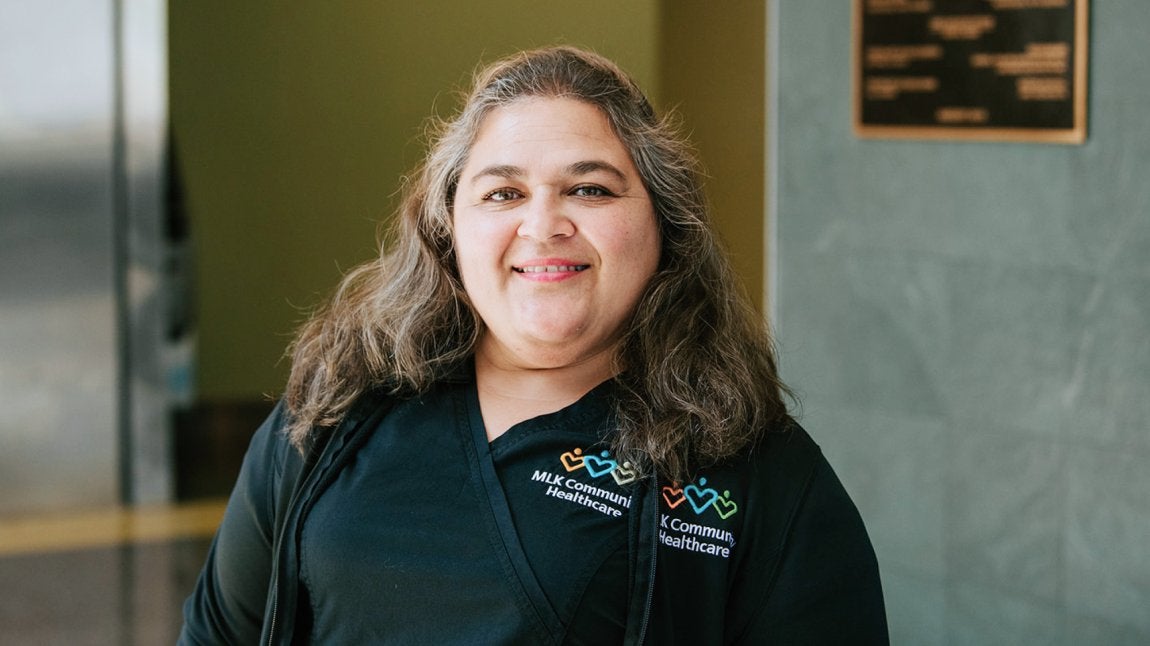
Portrait of MLKCH Employee Wendy Perez-Herrera

For Wendy Perez-Herrera, the commute from home to her desk at MLK Community Healthcare is a breeze. She walks a few doors down and arrives at the Wilmington Clinic to begin her day as a community health worker lead. That role, and the extremely close proximity to her work, underscore how strongly the idea of community guides Wendy in everything that she does.  

Her understanding of the importance of community began in childhood. She still remembers what it felt like when her family first immigrated from El Salvador to Compton when she was seven. Leaving a close-knit family of aunties, grandparents, and neighbors behind was a shock. No longer could she walk down the street and see the familiar faces of her loved ones. 

“You have to get to know and trust people. It takes time. But that’s hard for a child to understand,” says Wendy. Gradually, she saw how the neighbors in her new home could become her community. They checked in on one another and kept their eyes on the kids playing outside. Teachers consoled her when she cried from homesickness, and they let her learn to trust them on her own time. Her community became a steadying presence, one that she knew she could rely on. They reminded her that there was a way to carry over the traditions of one home to create another. 

As an adult, Wendy knew she wanted to support others in the way those neighbors and teachers supported her. She had long seen MLKCH as part of her community. She’d watched as the new health campus was constructed—glimpses of the inpatient tower from the freeway became her sign that she was almost home. She thought to herself, “It’s part of my community. I want to be part of that.” 

You have to get to know and trust people. It takes time. But that’s hard for a child to understand.

Wendy Perez-Herrera
MLK Community Hospital staff member

Now, working in extended care management allows Wendy to be a steady and consistent presence in her patients’ lives. Each day, she works to support patients who are struggling to manage their medical care—whether that’s scheduling transportation to an appointment, ensuring that a patient has a phone to receive notifications and messages, or even meeting a patient at an appointment. 

She remembers a diabetic patient who came in for a shoe fitting. He asked her to be in the room with him. When the shoe fitter pointed out a wound on the man’s foot, the patient wanted to ignore it. But Wendy made him an appointment with MLKCH podiatrist Dr. Hall—and then spent two days talking to both the patient and his sister, trying to convince them to take the wound seriously. “It turned out he had an infection in the foot,” says Wendy. “If he left it any later, it would’ve been a toe amputation.” 

In many ways, Wendy’s become like the community members who once watched over her and the teachers who let her take time to build trust. She knows, “I can’t just tell a patient, ‘I’ll call you on this date.’ I have to demonstrate they can rely on me by showing up and earning their trust.”

Now, everything that Wendy has learned about caring for her community has gone into her first book—a children’s book she wrote and illustrated, called “El Peche.” It uses the adventures of a little fish to bring Wendy’s childhood memories, Salvadoran culture, and family traditions to life. She’s also added “El Peche: Colores de El Salvador,” a coloring book, to the lineup. Both books reflect her belief that staying connected to your roots can help children feel a stronger sense of identity, belonging, and connection to their community. “Being culturally rooted is so important,” says Wendy. “My books are a reminder that culture connects us together. And having those roots helps you become who you are, helps you thrive.” 

Wendy’s family now has roots that have also become deeply intertwined with MLKCH. Her daughter volunteered at and now works as a patient transporter at the hospital. Her niece chose to give birth to her son at MLKCH last year, and her children are patients of Dr. Wong and Dr. Doshi. And Wendy’s aunt, Maria Garcia, was  2025 Dream Show, which followed her as she learned to cook healthy foods and manage her diabetes through the Recipe for Health program. Together, they embody the idea of “all us, all in,” giving and receiving the gifts of belonging to a strong community.

Decades after leaving El Salvador, Wendy has managed to build a new community that feels like family. It doesn’t get any closer than that. 


Other Tags